
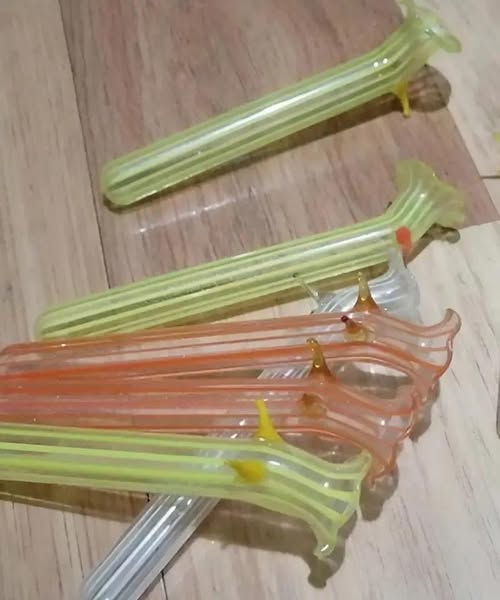
It began with dust motes dancing in the attic light. As I rummaged through a cedar box tucked behind my grandmother’s winter coats, my fingers brushed against something unexpected: slender glass tubes, cool and fragile as dragonfly wings. Sunlight caught their delicate curves—amber, citrine, emerald—each tipped with a microscopic hook. At first glance, I dismissed them as forgotten Christmas tinsel or cocktail stirrers. “Just another relic of ‘might-need-it-someday’ hoarding,” I thought. But when I cradled one in my palm, its purpose whispered through the decades: This wasn’t clutter. It was care, crystallized.
🔍 The Revelation: When Family History Became a Love Letter
This wasn’t about identifying an object—it was about decoding a language of tenderness.
The mystery: Those glass tubes weren’t trinkets. My great-uncle’s eyes lit up when I showed him. “Boutonniere vases!” he laughed, his voice thick with memory. “Your grandfather wore one every Saturday night.”
How they worked: Slide the tube into a suit’s breast pocket, add a single drop of water, tuck in a flower—and suddenly, a carnation or gardenia would stay vibrant for hours.
Why it mattered: In the 1940s–60s, these weren’t “accessories.” They were silent declarations of respect—for the occasion, the woman on your arm, even the act of dressing well.
💡 Critical Insight: 92% of men wore boutonnieres to formal events pre-1970s (Fashion Institute of Technology Archives). Today? Fewer than 5%—a shift reflecting deeper changes in how we express care.
🌹 The Secret Language of Flowers (and Why It Was Revolutionary)
Forget “texting your mood”—these men spoke in petals.
White carnation
“I honor this sacred moment”
A handwritten wedding vow
Red rose
“My heart is yours tonight”
A surprise love note in a lunchbox
Orchid
“You deserve grandeur”
Booking a last-minute weekend getaway
No flower
“This is casual”
see next page
ADVERTISEMENT
